Oversize Load Restrictions by State: Weekend, Holiday, and Nighttime Travel Rules
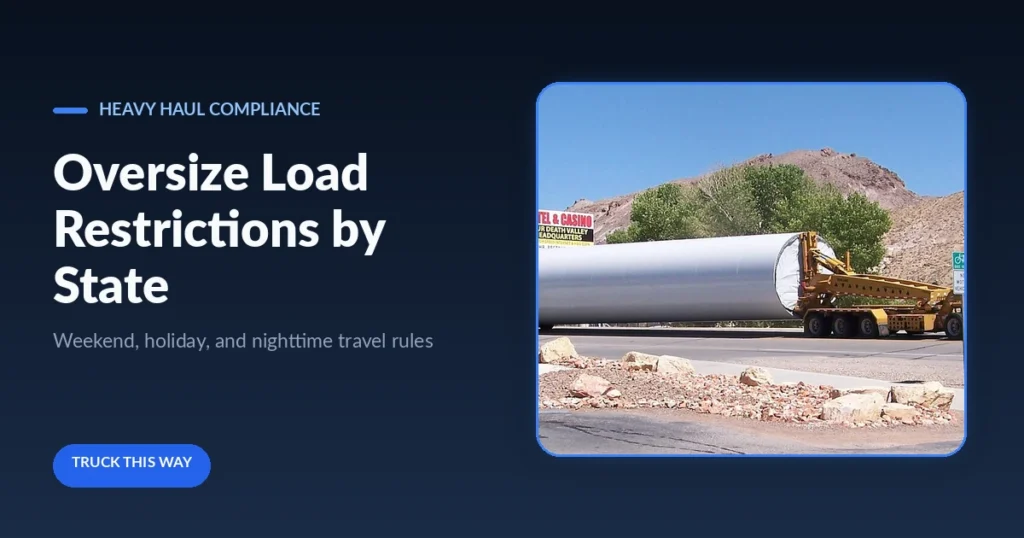
Oversize Load Restrictions by State: Weekend, Holiday, and Nighttime Travel Rules
Your oversize permit is approved, the load is chained down, and the driver is ready. Then dispatch calls: the move can’t roll until sunrise Tuesday because of a holiday restriction. Oversize load restrictions by state are the most common reason a legal heavy haul gets delayed at the last minute — and the rules are not federal, not uniform, and rarely explained in one place.
Why Oversized Loads Face Travel Restrictions at All
A permitted oversize load is already an exception to normal traffic rules. It is wider, taller, longer, or heavier than the road was designed for, and it usually needs pilot cars, police escorts, or lane closures. A 16-foot-wide load occupies two lanes and moves slowly, so states limit when that exception applies. Restrictions exist to keep high-traffic periods safe: holiday traffic, metro rush hour, and low-visibility night conditions are when a wide load creates the most risk and the longest backups.
Holiday and Weekend Blackout Periods
Nearly every state shuts down oversize and overweight movement around major holidays. The pattern is remarkably consistent: restrictions typically begin at noon on the day before the holiday and run until sunrise on the day after. Memorial Day, Independence Day, Labor Day, Thanksgiving, and Christmas are the most widely restricted dates. Overwidth or overheight loads — often anything wider than 14 feet, taller than 16 feet, or longer than 110 feet — face the strictest windows. Wisconsin, for example, blocks travel during specific afternoon windows on restricted-travel holidays, and Missouri publishes an annual holiday calendar with noon-to-sunrise blackouts.

Nighttime Travel: Daylight-Only by Default
Most states restrict oversize loads to daylight hours, commonly defined as 30 minutes before sunrise to 30 minutes after sunset. An unlit, overhanging load is nearly invisible at highway speed, and many oversize loads project beyond the truck’s marker lights. Night movement is not impossible — several states issue nighttime permits when the load is within certain dimensions and the truck runs enhanced 360-degree lighting, reflective markings, and often an escort. Other states prohibit oversize movement after dark outright. Texas, for instance, permits nighttime interstate travel for loads under certain length and width thresholds, while Georgia bans most nighttime oversize moves entirely.
Commuter Corridors and Metro Curfews
Even a fully legal daytime move can be barred from a specific stretch of road at a specific hour. Dense urban corridors frequently carry curfews tied to peak commute times — morning and evening rush hour on the routes a wide load must use. Weekend daytime restrictions appear too: some states stop oversized movement late Friday afternoon and don’t resume until Monday sunrise, which forces a Sunday-night staging plan instead of a Friday departure. These curfews usually attach to the permit itself, so the corridor rules that apply to your load are printed on the document, not published nationally.

Seasonal and Weather Restrictions
Restrictions are not only about time of day. Northern states impose spring thaw weight restrictions each year, when saturated roadbeds can’t carry normal axle loads — posted limits can drop allowable weights dramatically for weeks. Winter storms trigger temporary closures at the state level, and high-wind advisories restrict tall or light loads on exposed bridges and mountain passes. Add construction-season lane restrictions and you get a compliance target that changes week to week.
How to Find the Rules That Apply to Your Move
There is no single national source. Start with the permit itself: the operating hours, curfews, and holiday blackout windows are conditions of the permit, and violating them can void your legal authority to be on the road. Then confirm current conditions with the issuing state’s DOT permit office and check the state’s 511 traveler system for weather and construction closures. If your route crosses multiple states, each state’s restrictions apply only to the miles you travel inside its borders — which is why a single long haul can run into several different curfews.

Planning Around Restricted Travel Windows
The carriers who avoid delays treat restrictions as part of route planning, not an afterthought. Build the legal travel window into the schedule before you promise a delivery time: if a load can only move between sunrise and sunset, a 400-mile day becomes a two-day run, and a holiday weekend can add three more. Stage the truck near the state line so it can enter at first light, confirm escort availability for the hours you’re moving, and carry a backup plan for weather closures on mountain routes. Route-planning software that flags low bridges and restricted corridors is only half the job; the hours you may legally travel matter just as much.
The Bottom Line
Oversize load restrictions by state come down to three variables: when you may move, where you may move, and what happens if you don’t comply. Assume daylight-only travel unless your permit says otherwise, expect holiday blackouts to start at noon the day before, and verify corridor curfews state by state. Plan the legal window first and the route second — that’s how heavy haul stays profitable instead of parked waiting for sunrise.
Leave a Reply