What Is DEF? Diesel Exhaust Fluid Explained for Heavy Haul Truckers
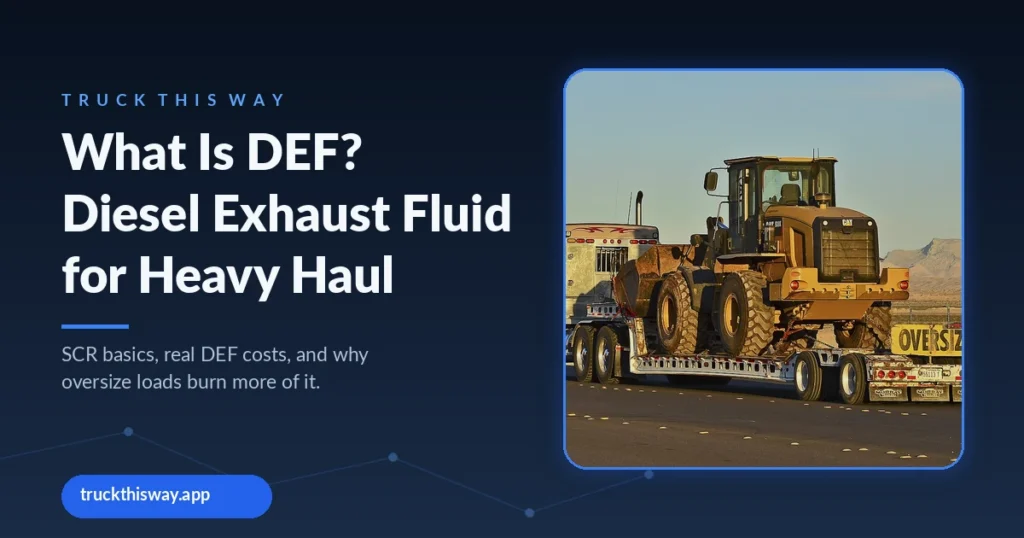
If you drive a diesel truck built in 2010 or later, there is a blue-capped tank that has nothing to do with fuel — and running it dry can cut your road speed to a crawl. Diesel exhaust fluid (DEF) is the consumable that keeps your selective catalytic reduction (SCR) system working, and for heavy haul operators the numbers matter more than they do for a dry van running light freight.
What Is DEF and What Is It Made Of?
DEF is a precise mixture of 32.5% automotive-grade urea and 67.5% deionized water, blended to the ISO 22241 standard. It is not a fuel and not a fuel additive: it is injected into the exhaust stream ahead of the SCR catalyst, where heat turns the urea into ammonia. That ammonia reacts with nitrogen oxides (NOx) over the catalyst and converts them into harmless nitrogen and water vapor.
Because the ratio is that specific, “close enough” chemistry is not an option. Tap water, farm-grade urea, or fluid contaminated with diesel will foul the injector, coat the catalyst, and trip a quality warning on the dash.
Why Every Modern Diesel Truck Needs It
EPA rules that took effect in 2010 pushed almost every new highway diesel engine to SCR as the cheapest way to hit NOx targets without wrecking fuel economy. If your tractor is a 2010 or newer model year, assume you own an SCR system — and that it monitors both how full the DEF tank is and how good the fluid tastes.

How Much DEF Does a Truck Use?
Most heavy-duty SCR engines consume DEF at roughly 2% to 3% of diesel volume — a common rule of thumb is one gallon of DEF for every 50 gallons of diesel. Loaded heavy haul sits at the top of that range: pulling 130,000 pounds up a long grade at low speed burns far more fuel than a light load at cruise, and the dosing follows the fuel burn.
A 10- to 15-gallon DEF tank covers plenty of miles on a fill — until mountain grades and long rural gaps between travel centers make it feel small.
What DEF Costs and Where to Buy It
Bulk DEF at the pump is almost always cheapest, commonly $2.50 to $4.50 per gallon depending on region and volume. Retail 2.5-gallon jugs run roughly double that per gallon, with 55-gallon drums landing in between.
For heavy haul, access matters more than price. Permitted routes often run through stretches with few large travel centers, and a dedicated DEF pump lane is not guaranteed. Buy bulk where it is cheap and carry a sealed jug as insurance.

DEF Freezing Point and Cold Weather
DEF freezes at about 12°F (-11°C), which means it is a slushy solid for much of a northern winter. Freezing itself does not ruin the fluid: it expands roughly 7% as it crystallizes, which is why tanks, lines, and jugs are built with headroom, and why most modern trucks heat the DEF tank and lines with engine coolant. It thaws back to a usable liquid without losing effectiveness.
The winter risk is contamination, not freezing. Never add water to stretch a jug, and do not park a half-used container where snowmelt can seep in.
Shelf Life and Storage Rules
DEF has a shelf life, and heat is what shortens it. Stored around 77°F it holds quality for roughly a year; manufacturer charts run from about 36 months at 50°F down to roughly six months at 95°F. Keep containers sealed and out of direct sunlight, and rotate stock so the oldest jug goes in the tank first.

How DEF Affects Route Planning and Compliance
Running out of DEF is not like running out of fuel. Federal inducement rules require the engine to derate: power is cut first, then vehicle speed is capped — often at 5 mph — and eventually the truck will only idle. A roadside top-off from a sealed jug resets the fault, but the time lost on a permitted move costs far more than the fluid.
That makes DEF a compliance item to plan around. Build your route with travel-center stops that actually pump bulk DEF, note long rural gaps on the permit path, and keep enough in the tank that weather, grades, and detours cannot strand you in derate.
The Bottom Line
DEF is cheap, simple, and unforgiving about quality. Buy it in bulk where you can, keep a sealed spare, watch the shelf life on stored jugs, and treat the tank level the way you treat fuel when planning an oversize move. Do that and the blue tank stays a cost line — not a road failure.
Leave a Reply