What Is a Superload? Permits, Escorts, and Requirements for Heavy Haul Truckers
What Is a Superload? Permits, Escorts, and Requirements for Heavy Haul Truckers
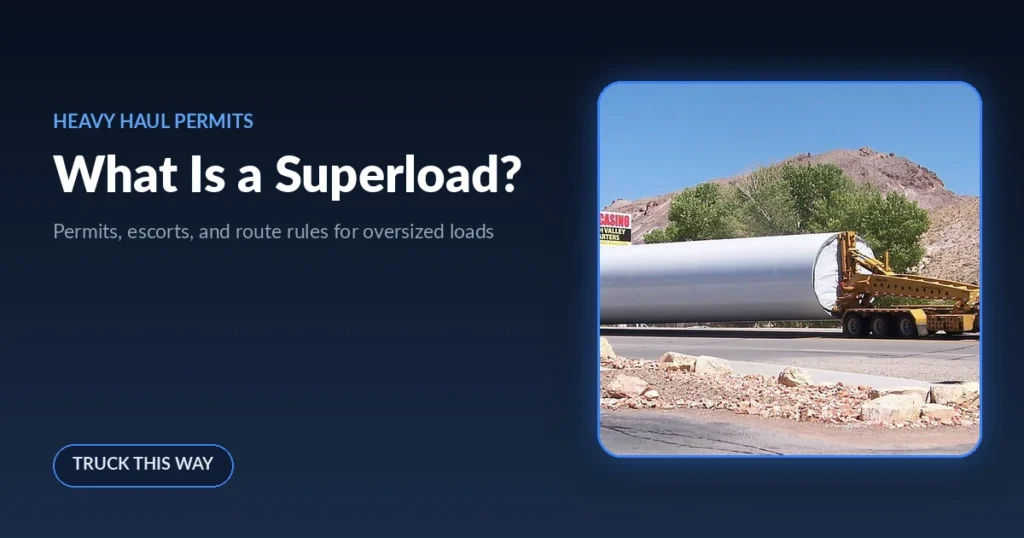
Some loads are simply too big for an ordinary oversize permit. Past roughly 16 feet wide, 180,000 pounds, or a quarter-million pounds gross, states stop treating your freight as routine heavy haul and start treating it as a superload. That single classification changes the permit, the engineering review, the escorts riding with you, and the hours you are allowed to travel. Here is how the superload tier works and what it takes to move one legally.
What Counts as a Superload
There is no single national definition. A superload is any oversize or overweight load that crosses a second, higher tier of state thresholds — and every state draws that line in a different place. Georgia, for example, defines a “Superload Single” as a load whose width or height exceeds 16 feet, or whose gross weight falls between 150,001 and 180,000 pounds. Anything over 180,000 pounds becomes a “Superload Plus,” and oversized mega loads are filed under a separate category.
Texas uses the term superheavy: non-divisible loads that may exceed 254,300 pounds gross, or 200,000 pounds when axle spacing is under 95 feet. Because the thresholds are set state by state, the same machine can be a routine permitted load in one jurisdiction and a superload in the next.
How Superload Permits Differ From Standard Oversize Permits
A standard oversize permit is largely an administrative transaction. You enter dimensions, pay the fee, print the permit, and roll. A superload permit is an engineering review. When weight or configuration may exceed a bridge’s rated capacity, the state has to analyze the route: bridge load ratings, culvert capacity, axle-by-axle weight distribution, and sometimes a structural review that takes days rather than minutes.
That is why lead times stretch. Georgia notes that single-trip superload permits may take up to three days for approval, and unusual configurations can take longer. Applying the morning you want to move is not an option.

Superload Permit Costs
Fees scale with complexity. A routine single-trip oversize permit often costs $10 to $100, while superload tiers climb into the hundreds: Georgia charges $125 for a Superload Single, $500 for Superload Plus, and $500 for a Mega Load. Those are permit fees alone, before route surveys, engineering charges, and escorts.
That is why dimension control is the biggest cost lever in heavy haul. If the load can be partially disassembled, shipped in two pieces, or loaded lower to stay under a height threshold, you may drop out of the superload tier entirely. Shaving a few inches off the height or redistributing weight across more axles is often cheaper than the engineering review itself.
Escort and Pilot Car Requirements
Superloads rarely travel alone. Most states require at least one certified pilot car once a load exceeds about 12 feet in width, with a second escort added as width grows past roughly 14 to 16 feet. Rear escorts become mandatory on multi-lane highways where traffic cannot safely overtake, and height or rear overhang can trigger additional escort requirements on their own.
At superload dimensions you should expect stricter escort qualifications, lighting and signage rules, radio communication between the lead car and the driver, and in some states a uniformed police escort for specific movements. Escort costs are usually billed hourly and can easily exceed the permit fee on a long route.

Route Restrictions and Travel Curfews
Nearly every state limits when a superload may move. Daylight-only travel is the norm, with no movement on holidays, during peak commuter hours, or on heavily traveled weekends. Restrictions are written into the permit, and running outside the permitted window is treated the same as running without a permit at all.
Route surveys drive the rest. Surveyors flag bridges with reduced ratings, culverts that cannot carry the weight, overhead wires that need clearance, railroad crossings requiring flaggers, and traffic signals that have to be temporarily raised or rotated. Loads over 16 feet high usually trigger a utility clearance request with the power or telecom owner, and urban routes frequently need written municipal approval on top of the state permit.
How to Plan a Superload Move
Start the permit application a week or more ahead of your target date and work from verified dimensions and axle weights — states reject applications built on estimates. Get the route survey and bridge clearances in writing before dispatch, confirm the exact escort count so you are not held at the county line, and plan fuel and rest stops where a superload configuration can actually park.
Finally, use route-planning software that understands height, width, and weight restrictions rather than a consumer navigation app. A routing tool that knows your permit limits keeps you on approved roads, out of low-clearance traps, and inside the curfew window your permit allows.
The Bottom Line on Superloads
A superload is an oversize load in a higher regulatory tier: more engineering, higher fees, more escorts, and tighter travel windows. Check the threshold for every state on your route, apply early, and control your dimensions where you can. The drivers who profit on superloads are the ones who plan the permit and the route before the load is ever chained down.
Leave a Reply