Oversize Load Permit Illinois: Requirements, Cost, and How to Apply
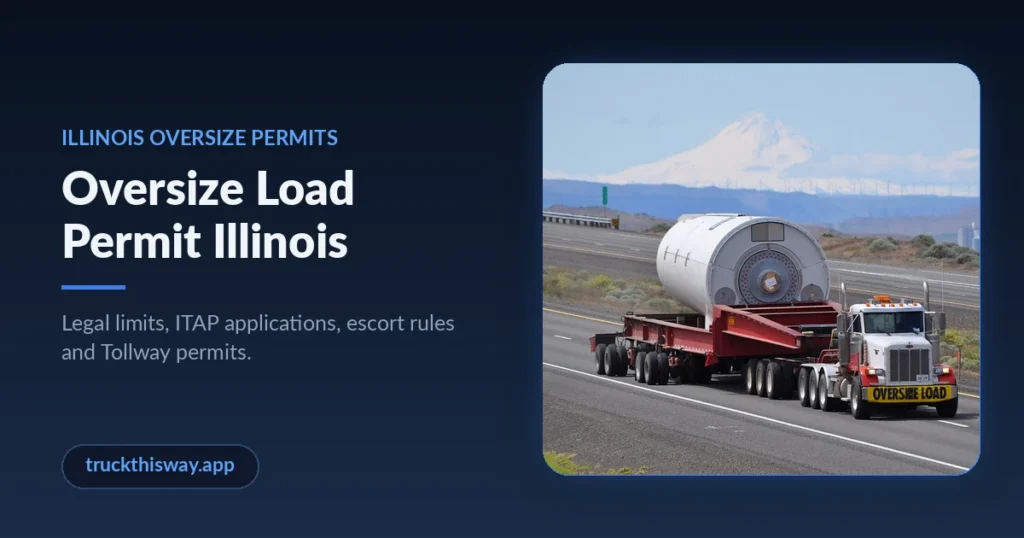
Illinois sits on three of the busiest freight corridors in the country, and its permit rules are stricter than most. Legal height is only 13 feet 6 inches, and the Chicago region layers Cook County movement windows on top of state requirements. Here is how Illinois oversize load permits work, what they cost, how to file through ITAP, and the extra permits many haulers forget.

Illinois Legal Size and Weight Limits
Without a permit, Illinois allows 8 feet 6 inches of width, 13 feet 6 inches of height, and 80,000 pounds gross. Single axles are capped at 20,000 pounds and tandem axles at 34,000 pounds. That 13-foot-6-inch height limit is the number to remember, because a load that moved legally at 14 feet in Texas becomes overheight the moment it crosses the state line.
Length rules depend on the road. Illinois publishes separate legal length charts for designated and non-designated highways, and the trailer length you can legally run is longer on a designated corridor than on a local road. Check the specific highway before you quote.
When You Need an Illinois Oversize/Overweight Permit
An IDOT permit is required whenever a vehicle or load exceeds legal size or weight and moves on a state highway. IDOT reviews every application for bridge tolerances, construction zones, and vertical clearance, which is why Illinois permits are route-specific.
If your route needs roads that IDOT cannot permit, you must also obtain permission from the local authority that owns them. That is routine around Chicago, where city streets, county roads, and toll facilities each have their own process.
How to Apply Through ITAP
Applications are filed through ITAP, the Illinois Transportation Automated Permit System at webapps.dot.illinois.gov/ITAP. Most permits are issued immediately and can be carried electronically. Form OPER 993, the general provisions document, is legally part of your permit and must travel with the vehicle.
The IDOT Permit Office is at 2300 South Dirksen Parkway in Springfield. Call 217-785-1477 from out of state or 800-252-8636 from within Illinois. Overdimension permits are inexpensive compared with most states, but overweight fees climb sharply above the 80,000-pound legal limit, so a load that only needs extra width is far cheaper to permit than a heavy one.
Illinois Escort and Pilot Car Requirements
Illinois requires one civilian escort for any move that exceeds 14 feet 6 inches wide, 14 feet 6 inches high, or 110 feet long. If a load exceeds two or more of those thresholds at the same time, two or more escorts are required. Escort vehicles are not optional extras, and understaffing them is one of the fastest ways to have a move shut down.
Insurance is required too. Escort vehicles and oversize loads exceeding 10 feet wide, 13 feet 6 inches high, or 110 feet long, and all overweight loads, must carry at least $500,000 in liability coverage per occurrence. Some configurations also require an Illinois State Police escort, in which case the permittee must notify ISP Central Office at 217-782-6527 at least 24 hours before the move and notify the IDOT District Highway Engineer as well.
Movement Hours, Cook County, and Holidays
Illinois ties authorized travel hours directly to load size. Loads up to 12 feet wide, 13 feet 6 inches high, and 200 feet long may travel 24 hours a day, with one additional civilian escort required during the hours of darkness. Loads up to 14 feet 6 inches wide and 15 feet high may travel from half an hour before sunrise to half an hour after sunset, seven days a week.
Above that, loads up to 16 feet wide and 17 feet high may only move during daylight Monday through Friday and until noon Saturday. Loads beyond 16 feet wide or 17 feet high are restricted to 9 a.m. to 3 p.m., Monday through Friday, with no weekend movement.

Cook County adds its own layer. Expressway movements there are restricted to loads no wider than 12 feet, no higher than 13 feet 6 inches, and no heavier than 120,000 pounds. In Cook, DuPage, Lake, Kane, Madison, McHenry, Monroe, St. Clair, and Will counties, loads wider than 14 feet 6 inches may only move between 9 a.m. and 3 p.m. on weekdays. Oversize movements are also restricted on specific holidays and holiday weekends, so confirm the dates before you schedule.
Illinois Tollway and Local Permits
An IDOT permit does not cover the Illinois Tollway. Tollway moves need authorization from the Illinois Tollway permit office in addition to the state permit, and Cook County and the City of Chicago add their own requirements on top. Overdimension tollway permits are inexpensive, but a missing one still stops your load at the plaza and can trigger fines.
Build every layer into the route plan before dispatch: state permit through ITAP, tollway authorization, county and city permits where the route demands them, and the escort count that matches your dimensions.
The Bottom Line
Illinois is a low-cost permitting state with unforgiving geometry: 13 feet 6 inches of legal height and tight Chicago-area movement windows. Confirm your dimensions, file through ITAP, add the tollway and local permits, and schedule around the correct travel hours. Do that and one of the country’s busiest freight corridors becomes predictable instead of painful.
Leave a Reply