Oversize Load Permit Texas: Requirements, Cost, and How to Apply
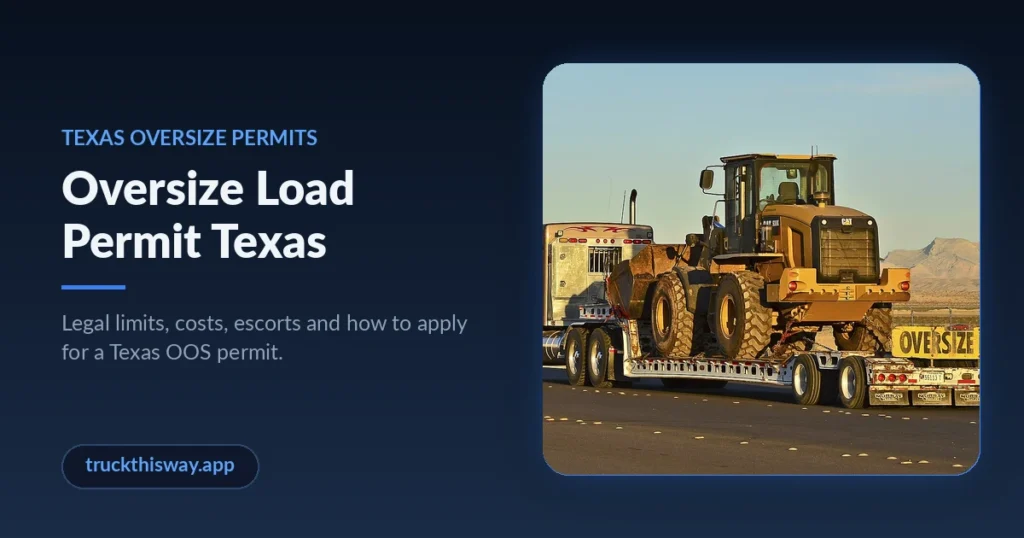
Texas moves more oversize freight than almost any other state, and its permit rules reflect that. From wind turbine components on I-35 to oilfield equipment crossing the Permian Basin, every load over legal size needs a Texas oversize load permit before it rolls. Here is what counts as oversize, what a permit costs, how to apply through TxPROS, and the escort rules that trip up first-time haulers.

What Counts as Oversize in Texas?
Texas sets its own legal limits, and they are more generous than most states. Without a permit you may run up to 8 feet 6 inches wide, 14 feet high, and 80,000 pounds gross. A semitrailer in a two-vehicle combination can be 59 feet long. Anything beyond that needs a permit from the Texas Department of Motor Vehicles (TxDMV).
Texas allows 14 feet, higher than the 13-foot-6-inch ceiling in many states. A load that is legal leaving Laredo can be overheight the moment it crosses into New Mexico. Weight is capped per axle too: 20,000 pounds single, 34,000 tandem, 42,000 triple, and 50,000 quad.
Texas Oversize Permit Types and Costs
TxDMV issues single-trip and annual permits, plus specialty categories for manufactured housing, portable buildings, and Super Heavy loads. A routine single-trip oversize permit starts around $60, and the fee climbs with weight. Overweight permits are tiered, so a load between 80,001 and 120,000 pounds costs substantially more than a legal-weight oversize move.
Loads far above permitted axle or gross weight limits need a Super Heavy single-trip permit, which involves an engineering review. County and highway-use fees add to that total. Annual permits suit carriers who move the same oversize equipment repeatedly, but they cover only specific configurations.
How to Apply for a Texas Oversize Load Permit
Applications go through TxPROS, the Texas Permitting and Routing Optimization System at txpros.txdmv.gov. You will need your USDOT number, Texas Motor Carrier Registration or Unified Carrier Registration, proof of insurance, and the exact loaded dimensions of the move. Most standard permits are issued immediately, and the system generates an approved route at the same time.

Larger loads clear extra hurdles. Anything over 20 feet wide, 18 feet 11 inches high, or 125 feet long requires a route inspection certification on file before TxDMV issues a permit. Any load 19 feet or taller requires the operator to physically inspect the route and certify in writing that every overhead obstruction can be cleared. Carry the permit in the cab, in print or electronic form, and remember it covers only the permittee.
Escort and Pilot Car Rules in Texas
Texas ties pilot car requirements to width, height, and length. One escort is required for loads over 14 feet and up to 16 feet wide, while two escorts are required above 16 feet wide. Loads over 18 feet high need front and rear escorts. For length, one escort covers loads from 110 to 125 feet, and anything longer needs escorts front and rear.
Position matters: the escort must lead the load on a two-lane highway and follow it on roads with four or more lanes. Any permitted vehicle over 17 feet tall needs a front escort carrying a nonconductive height pole, and a load 18 feet or higher needs a pole on the front escort regardless. Escort vehicles must weigh between 1,000 and 10,000 pounds gross and stay in two-way radio contact with the truck.
Permit Size Limits and Holiday Restrictions
With a Texas permit, loads may run up to 16 feet wide on controlled-access interstate highways, but only 14 feet during holiday travel periods. Height can reach 18 feet 11 inches and length 125 feet when a route inspection certification is on file. Travel on restricted holidays is prohibited or limited, so plan around major travel weekends or your permit may not authorize the move.

Two other details catch haulers out. Overweight permits are not issued for posted bridges, and travel on load-zoned roads cuts permitted axle and group weights by 10 percent. A tandem that is legal on a normal route becomes overweight on a load-zoned stretch, so check the TxDOT bridge and load-zone maps before you dispatch.
Route Planning Keeps a Texas Oversize Move Legal
A Texas permit authorizes a specific route, not a destination. Low clearances, load-zoned bridges, construction zones, and city restrictions all change the legal path, and the TxDMV low-clearance map plus the TxDOT load-restricted bridge map are worth checking before you apply. Get the dimensions wrong and the permit is void, which can mean fines, a re-permit, and a stranded load on the shoulder.
Measure loaded height from the roadbed to the highest point of the load or vehicle. Measure width from the outside edges of the widest extremities, excluding safety devices. Those two numbers decide your permit type and escort count.
The Bottom Line
Texas is one of the more forgiving states for oversize haulers, but forgiving is not the same as simple. Confirm your dimensions, apply through TxPROS, order the correct escorts, and check clearance and weight restrictions along the way. Doing that before dispatch is the difference between a smooth run and an expensive roadside stop.
Leave a Reply