Colorado Chain Laws: When Trucks Must Chain Up
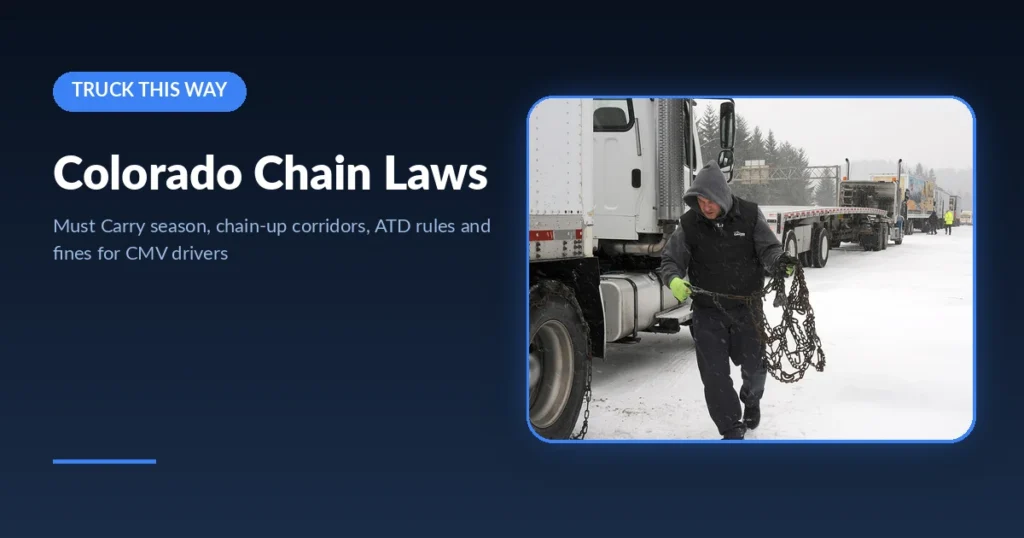
Colorado Chain Laws: When Trucks Must Chain Up
Colorado’s chain season runs September 1 through May 31, and the state’s Must Carry Law applies whether or not the sun is shining when you roll through Denver. If you operate a commercial motor vehicle at or above 16,001 pounds on any of seven mountain corridors, chains or approved alternative traction devices need to be on board before the weather turns. Here is what the law requires, where it applies, and what noncompliance costs.
What Colorado’s Must Carry Law Requires
Senate Bill 24-100 expanded Colorado’s Must Carry Chain Law from a stretch of I-70 to seven key mountain routes, effective September 1, 2024. A commercial motor vehicle — a vehicle with a manufacturer’s GVWR or GCWR of at least 16,001 pounds used in commerce, or used to carry at least 16 passengers including the driver — must carry appropriate chains or approved alternative traction devices (ATDs) on those corridors from September 1 through May 31, RVs included. Roughly 1,400 centerline miles of Colorado highway fall under the rule, and the obligation to carry is constant through the season rather than conditional on the forecast.
Which Colorado Corridors Are Covered
The Must Carry requirement applies on these routes:
- I-70 west of milepost 259 (Morrison)
- CO-9 from milepost 63 to 97 (Frisco to Fairplay)
- US-40 west of milepost 256 (Empire)
- US-50 west of milepost 225 (Salida)
- US-160 west of milepost 304 (Walsenburg)
- US-285 west of milepost 250 (Morrison)
- US-550 from milepost 0 to 130
If your route touches any of them between September and May, the chains ride with you.
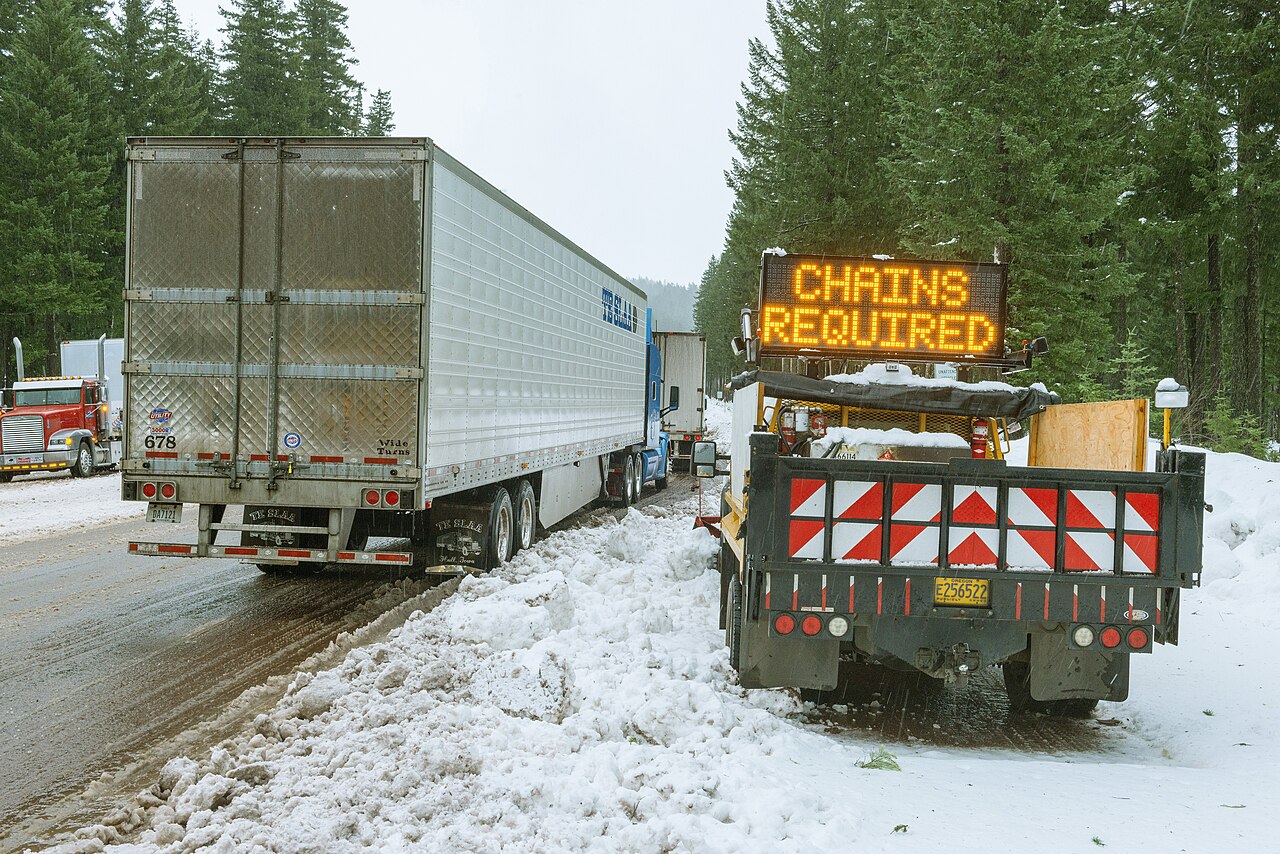
When the Chain Law Is Activated — and How Many Tires to Chain
Carrying chains is a season-long requirement. Installing them is triggered by the Commercial Motor Vehicle Chain Law, which CDOT and the Colorado State Patrol communicate through variable message signs, static signs, the COtrip travel site, email and text notifications — specifying by milepost and exit number where chains are required. When the chain law is active, a CMV must have chains or approved ATDs on at least four of the drive wheel tires, or on all drive tires if the vehicle has fewer than four. Buses and hot shots pulled by a pickup need chains on two drive tires. Passenger vehicles fall under a separate traction law.
What Counts as an Approved Traction Device
Tire chains must meet the SAE classification used by the National Association of Chain Manufacturers: two circular hoops connected by at least nine evenly spaced cross chains. Clip-on chains and any device not designated as an approved ATD are not permitted. Alternative traction devices must appear on CDOT’s Approved Product List, while drive wheel sanders and pneumatically driven chains also qualify. Tire cables can cover two tires on one drive axle if chains are on the two outside tires of the other, but Autosocks and tire cables cannot be used together.

What Noncompliance Costs
Failing to carry chains on the seven Must Carry corridors between September 1 and May 31 carries a $100-plus fine plus a $32 surcharge. Statewide, noncompliance with winter driving restrictions runs up to $500 plus a $78 surcharge, and if your rig is stuck and blocking any traveled portion of the roadway the fine is $1,000 plus a $156 surcharge. Law enforcement issued more than 1,300 Must Carry citations in the 2024–2025 season, so the rule is enforced.
Chain Stations and Chain-Up Practice
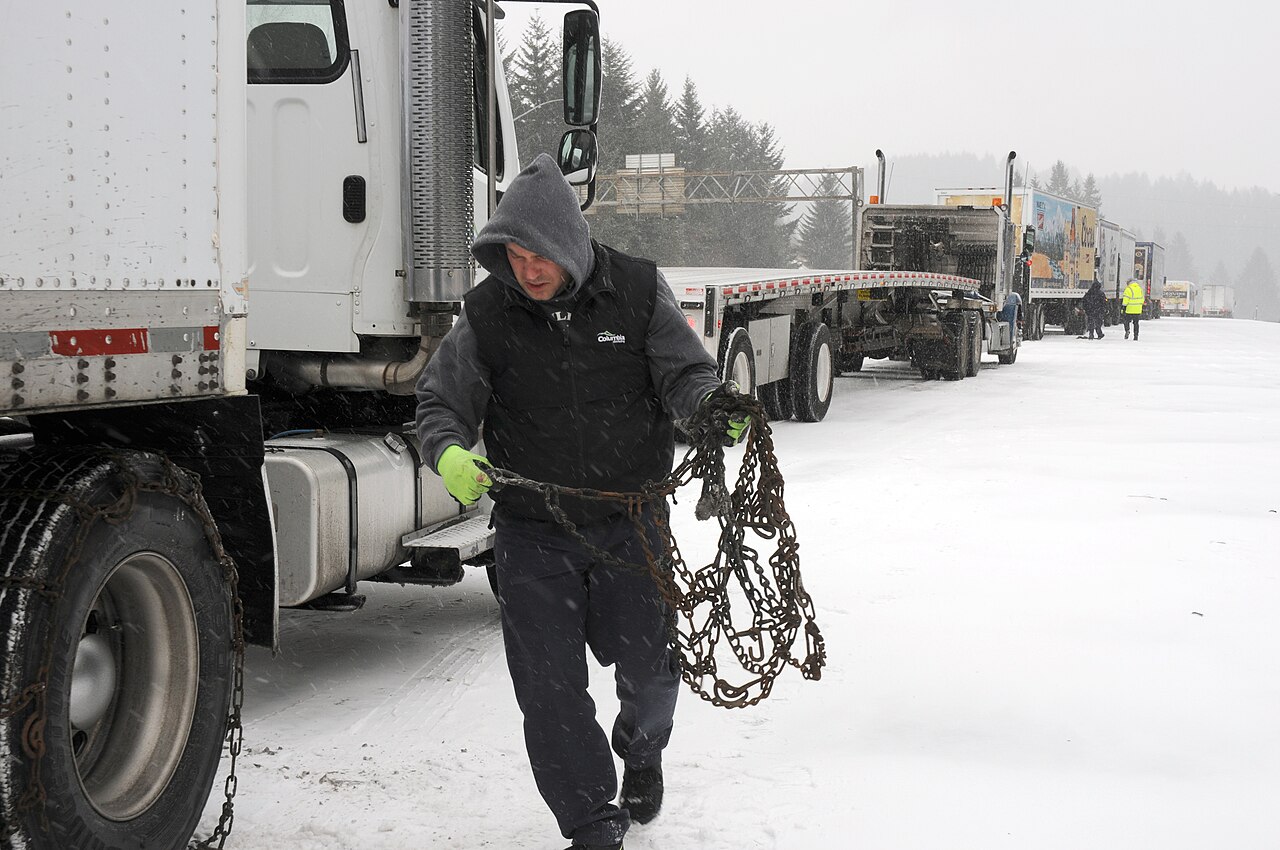
Colorado maintains about 130 designated chain stations, 22 of them on I-70’s mountain corridor. Chain up where there is room — a station, a shoulder with space, or a lot — never in a live lane. While the chain law is active, CMVs are restricted to the right lane except to pass a stalled or slower vehicle, and that pass must be completed without losing traction and with an immediate return to the right lane. Chains come off when CDOT signals the restriction has ended, or when the centerline or lanes are visible on a descending grade. Trailers do not need chains, and placarded hazmat loads may pass chain-up signs and install chains at a safe location outside the traveled portion of the highway.
What Chain Laws Mean for Oversize Loads
For oversize and overweight haulers, chain season stacks on top of permit conditions. Pilot escort requirements, area curfews, bridge weight limits and vertical clearances already narrow your routing choices on Colorado’s mountain corridors, and an active chain law can slow or stop a permitted move entirely. Plan winter runs around the Must Carry map and confirm current restrictions before you roll.
The Bottom Line
From September 1 to May 31, if your CMV is rated at 16,001 pounds or more and your route touches I-70, CO-9, US-40, US-50, US-160, US-285 or US-550, Colorado expects chains or an approved ATD on board. Carry the right device, know where the chain stations are, watch the signs, and budget for the fines if you run without them.
[…] to carry chains, and up to $1,000 plus $156 if you get stuck blocking the roadway. See our guide to Colorado chain laws for the full state […]